
A homeschool schedule for multiple ages is easier to use when it separates shared activities from the lessons that need individual attention. You can begin together, rotate focused help and give each learner an appropriate independent task or break while another child works with you.
The three examples below are planning patterns, not required school hours or recommendations for every age. Adapt them to your children's needs, curriculum, household responsibilities and the current requirements that apply where you live.
Download the multi-age homeschool schedule examples. Open Family Schedules for the three editable patterns. Child A, Child B and Child C are fictional labels for learners with different support needs.
Start with needs before clock times
List the work that requires your direct help. It may include a new reading lesson, a difficult math concept or a writing conference. Then list activities a particular child can do safely and independently, such as familiar practice, reading or preparing materials.
Do not assume independence from age alone. A learner may work independently in one subject and need help in another. Give an independent task a clear finish point, such as “complete these four familiar questions and mark any you want to discuss.”
Choose a few shared anchors: beginning the day, a read-aloud or discussion, and a closing review. Shared time creates a common routine while allowing the actual work to differ.
Example 1: A morning rotation
This pattern suits a household that has a relatively clear morning block. The durations are illustrative and include transitions.
| Block | Parent focus | Child A | Child B | Child C |
|---|---|---|---|---|
| Opening | Shared plan | Join discussion | Join discussion | Join discussion |
| Rotation 1 | Help Child A | Individual lesson | Familiar practice | Independent reading |
| Rotation 2 | Help Child B | Suitable independent activity | Individual lesson | Project task |
| Break | Pause and reset | Break | Break | Break |
| Rotation 3 | Help Child C | Familiar practice | Independent reading | Individual lesson |
| Closing | Review next steps | Share work | Share work | Share work |
Prepare the independent activities before the rotation starts. If another learner needs supervision, change the arrangement; the schedule should reflect the supervision actually available.
A rotation is complete when its planned work and check-in are complete, not because every learner has produced the same amount. Write down any follow-up lesson instead of stretching the entire day to finish every original intention.
Example 2: Shared topic, separate responses
Some topics allow a shared introduction with different tasks afterward. A family could read about a habitat together, then choose different ways to respond.
| Block | Shared element | Child A response | Child B response | Child C response |
|---|---|---|---|---|
| Introduction | Read or discuss the topic | Listen and ask questions | Listen and take a note | Note a question to investigate |
| Activity | Observe a related example | Draw and describe | Label and explain | Compare two observations |
| Focused work | Separate skill practice | Guided lesson | Individual task | Independent assignment |
| Review | Share what was learned | Explain drawing | Explain labels | Present comparison |
The topic is shared; the learning objectives are not necessarily identical. Record what each child actually attempted or completed. One family activity should not automatically copy the same assessment into every child's record.
Choose a shared topic because it supports the learners' plans, not simply because it makes the calendar look tidy. Some subjects or levels will need separate teaching.
Example 3: A split-day routine
A split-day pattern can help a household whose available teaching time is interrupted. It places different tasks into the blocks you truly have.
| Block | Suggested use | What to prepare |
|---|---|---|
| First available block | Shared check-in and one priority lesson | Materials for the lesson needing the most help |
| Middle independent block | Previously taught practice or suitable reading | Clear task instructions and a check-in plan |
| Later supported block | Individual follow-up and another focused lesson | Questions collected from the earlier work |
| Closing block | Record completed work and set tomorrow's first task | Each child's planner or record |
Independent work still needs to be appropriate to the child and the supervision available. If the household cannot support that middle block, leave it out or use it as a break.
Avoid filling every gap with schoolwork. Travel, meals, other responsibilities and rest need real space. A usable plan leaves room for the day to change.
Use one family view and separate child records
The family view answers “Who needs help now?” Each child's record answers “What did this learner do, and what comes next?” Those are different planning jobs.
In a weekly review, look for repeated waiting, unclear independent tasks and lessons that regularly need more time. Change one part of the schedule and observe what happens. For example, move a demanding individual lesson earlier or prepare a shorter independent task for the next learner.
For choosing a record-keeping setup, see a homeschool planner for multiple children. If you also need a daily participation log, use the homeschool attendance tracker guide.
Keep the schedule flexible without losing the record
Separate planned work from completed work. If a lesson moves, update the next step and keep an accurate note of what happened that day. You can retain a useful record without labeling every change a failure.
An unfinished task may need a smaller step, more explanation or a different day. Review why it moved before adding it to the next day's list. Repeatedly carrying forward an oversized task does not make it more manageable.
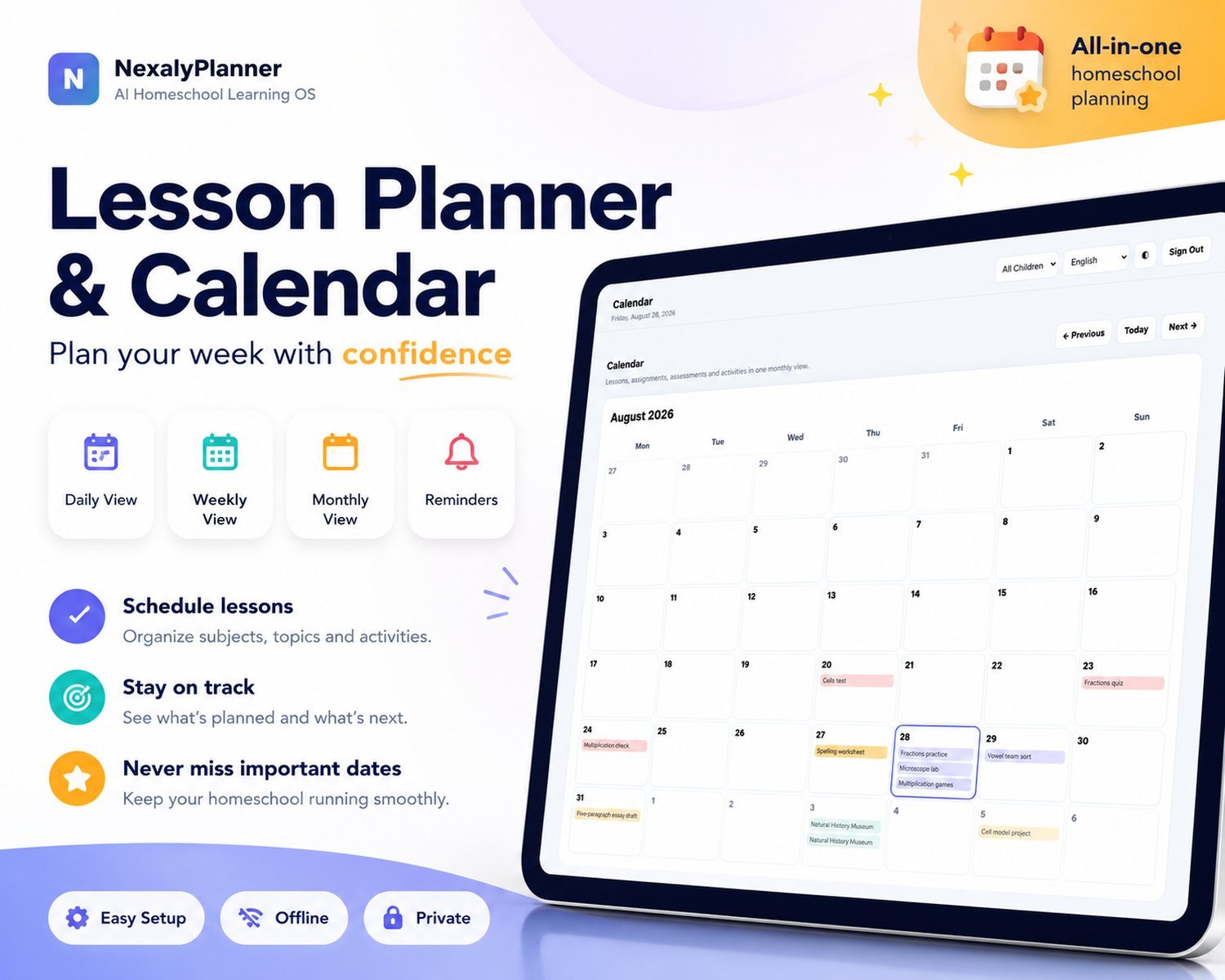
The NexalyPlanner Digital Homeschool Planner describes separate child profiles alongside lesson and record tools. Review its current product information to see whether that structure fits your family. The schedules in this article are original examples and do not represent an app performance test.
Test the rotation against the help actually available
A shared morning can look workable on paper while requiring one adult in two places. In this fictional household, Child A needs 20 minutes of direct reading support and Child B needs 15 minutes to learn a new math method. Those lessons cannot happen at the same time with one supporting adult. Familiar independent work is a separate category from new work that needs supervision.
Start with two consecutive support blocks. While the adult helps Child A, Child B uses a familiar task only if that activity and the available supervision are suitable. If not, change the arrangement, choose a break or delay the second lesson. Independence should be assessed from the actual learner and task, not assumed from age.
| Block | Adult's supported work | Other learner's plan | Evidence afterward |
|---|---|---|---|
| First support block | Child A's reading lesson | Child B's suitable familiar task or break | Child A's completed step and follow-up |
| Second support block | Child B's new math method | Child A's suitable familiar activity or break | Child B's attempted work and questions |
| Shared closing review | Briefly review both next steps | Both learners can contribute as appropriate | Separate notes for each child |
If Child A's lesson takes longer, record where it stopped and inspect the next block before moving it. Do not silently shift every later commitment. A short closing note might say, “Reading practiced to page 4; begin with the remaining example next session.” That gives the next adult or next day a usable starting point.
Use the multi-child planner checklist to test separate learner records and the attendance tracker to keep accurate participation records. This rotation is a planning example, not a prescribed teaching duration or a statement of state attendance rules.
Keep an interrupted day separate from the next plan
Suppose a planned shared habitat lesson stops after the introduction. Child A made an observation drawing; Child B has not started the follow-up explanation. Keep those different outcomes in the individual records. The family's original block shows the intention, while each child's completed work shows what actually happened.
Choose the next supported action for each learner before moving the remaining work: Child A might describe the drawing, while Child B first needs the observation activity. Place those actions in the next suitable blocks and check the support required. Do not copy the entire shared lesson as completed, move fixed appointments without checking them, or infer attendance from the rescheduled calendar.
The two-child record example shows how to keep objectives and outcomes distinct. Use the attendance summary review separately when a day's record remains uncertain.
Frequently asked questions
Can I teach children of different ages together?
You can share appropriate activities while giving different objectives or responses. Keep separate instruction where a learner needs it. The best grouping depends on the material and the children involved.
Does a multi-age schedule need exact times?
No. You can use an order of activities or flexible blocks. Fixed appointments may need clock times, while other lessons can follow a sequence.
What should another child do during an individual lesson?
Choose a familiar, suitable task, an appropriate activity or a break based on that child's needs and the supervision available. Prepare instructions before the individual lesson begins.
Do these examples satisfy homeschool attendance requirements?
They are scheduling examples. Use your current state guidance to determine the records and requirements that apply. The US Department of Education state resource directory provides a starting point for locating state-specific information.
Keep the schedule separate from completed attendance
A planned lesson is not a completed attendance entry. At the end of the day, record each learner's actual participation in the free downloadable homeschool attendance sheet. Use separate child/date rows when siblings complete different activities.