

Free supplier scorecard workbook
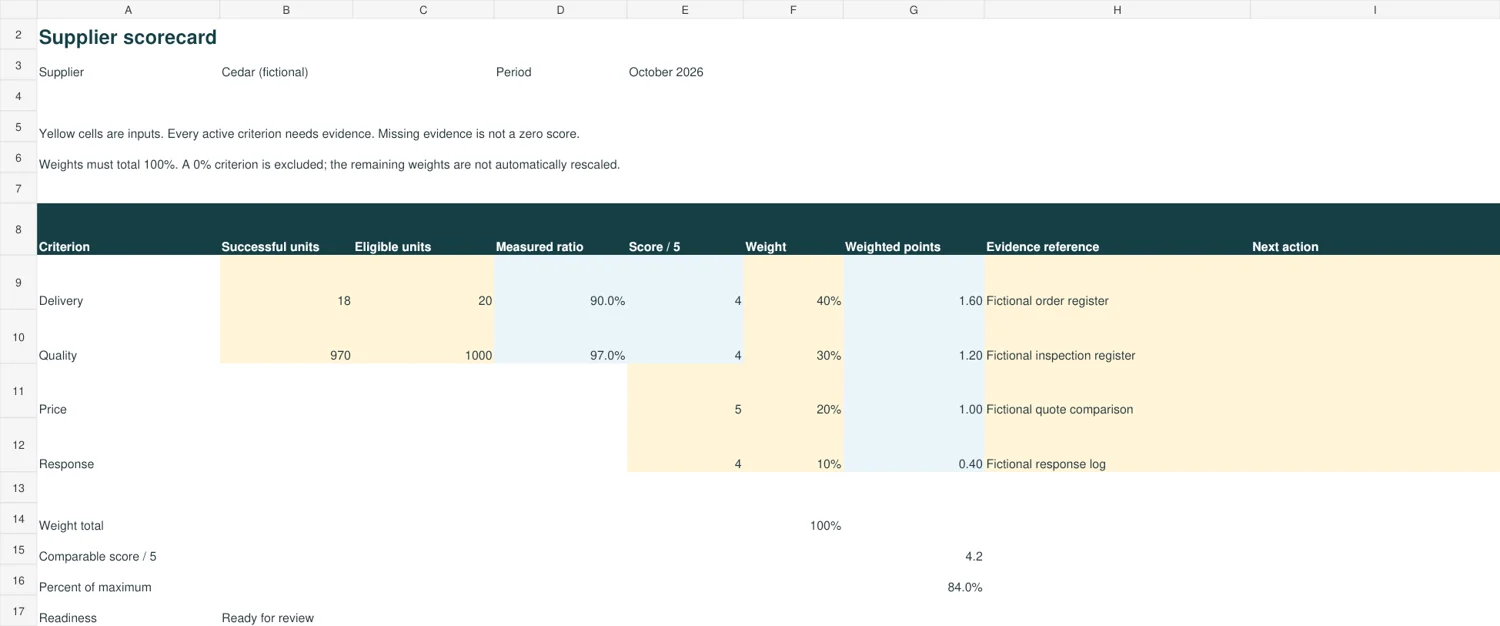
Use the editable scorecard to record delivery, quality, price and response for one supplier and review period. The fictional Cedar example scores 4.20 out of 5 with delivery at 40%, quality 30%, price 20% and response 10%.
Enter an evidence reference for every active criterion. The comparable total stays blank if an active score or evidence reference is missing, counts are invalid, or weights do not total 100%. A criterion with 0% weight is excluded; the workbook does not automatically rescale the remaining weights. Agree the included illustrative rating policy before comparing suppliers.
A supplier scorecard is a repeatable record of how a supplier performed during a defined period. Start with a few measures you can prove from purchase orders, receipts and issue records. Then use the score to choose a follow-up action, rather than treating one number as a complete verdict.
For a small business, a useful first scorecard covers delivery reliability, accepted quality, price consistency and response to problems. The example below uses fictional suppliers and an illustrative scoring policy. The weights and thresholds are choices for this example, not an industry standard.
Define the period and the evidence first
Write the supplier name, review dates, reviewer, number of orders and relevant product category above the table. Compare equivalent work. A supplier handling urgent custom items should not be ranked against routine replenishment without explaining that difference.
For delivery, keep the original agreed date and any approved change. Moving the promised date after a late delivery hides the problem. Record buyer-caused changes separately so the supplier is not penalized for a delay your business requested.
For quality, count accepted and rejected units under the same inspection policy. Ten purchases are not ten units; a quality percentage needs a unit denominator. If an order has not been inspected, label it pending instead of assuming it passed.
Copy this blank supplier scorecard
| Measure | Evidence and definition | Result | Score 1–5 | Weight | Action |
|---|---|---|---|---|---|
| Delivery | On-time completed orders / eligible completed orders | Enter numerator and denominator | Enter | 40% | Enter |
| Quality | Accepted inspected units / all inspected units | Enter numerator and denominator | Enter | 30% | Enter |
| Price consistency | Invoice/accepted quote differences investigated | Describe differences | Enter | 20% | Enter |
| Issue response | Documented response against agreed window | Record dates | Enter | 10% | Enter |
Keep the review notes with the underlying records. A missing record is “not measured,” not zero performance. Do not calculate a final comparable score until the missing measure is resolved or an explicitly documented alternative weighting rule applies to every comparable supplier.
Use a published scoring rule
This fictional shop assigns delivery scores as follows: 5 for at least 95%, 4 for at least 90% but under 95%, 3 for at least 80% but under 90%, 2 for at least 70% but under 80%, and 1 below 70%. It uses a separate quality rule: 5 at 99% or higher, 4 at 97% to under 99%, 3 at 95% to under 97%, 2 at 90% to under 95%, and 1 below 90%.
Price and response scores require written rubrics too. For this example, price score 5 means no unresolved discrepancy against accepted quote terms; score 4 means an isolated discrepancy was corrected before payment. Response score 4 means all recorded issues received acknowledgment within the agreed window, but one resolution exceeded its agreed date. A reviewer cannot invent a favorable score from memory.
Worked example: one supplier, one review period
Supplier Cedar completed 20 eligible orders; 18 arrived on time. Delivery is 18 / 20 = 90%, earning 4. Inspection accepted 970 of 1,000 units: 97%, also earning 4. Its price score is 5 and issue-response score is 4 under the written rules.
| Measure | Score | Weight | Weighted points |
|---|---|---|---|
| Delivery | 4 | 0.40 | 1.60 |
| Quality | 4 | 0.30 | 1.20 |
| Price | 5 | 0.20 | 1.00 |
| Response | 4 | 0.10 | 0.40 |
| Total | 1.00 | 4.20 / 5 |
The equivalent percentage of the maximum is 4.20 / 5 × 100 = 84%. It is a weighted rating, not a claim that 84% of orders were successful. The raw delivery and quality ratios answer those separate questions.
Turn the score into a specific conversation
Cedar's two late deliveries both involved the same item. Ask whether the lead-time assumption for that item should change. Set an owner and a date for the reply, then review the next comparable deliveries. Do not replace a supplier solely because the overall rating falls below an arbitrary threshold.
Sample size matters: one late order out of two produces 50%; one out of twenty produces 95%. Report the denominator beside the ratio. Serious safety or authenticity concerns also need direct investigation regardless of the average rating; a strong price score cannot cancel a critical defect.
A follow-up record you can copy
For the fictional Cedar review, the buyer records the two late PO lines and their original promised dates. The action is to ask Cedar to confirm a realistic lead time for the affected item. The purchasing owner requests a reply within five business days and reviews the next five comparable completed orders. These dates and sample sizes are illustrative choices, not a universal policy.
- Evidence: PO line references, promised dates, accepted receipt dates and any buyer-approved changes.
- Owner and deadline: named purchasing owner, supplier reply due date and next review date.
- Follow-up result: supplier response, agreed lead time, on-time numerator and denominator for the next review, and unresolved exceptions.
If the next five comparable orders all arrive on time, record 5/5 for that follow-up window; keep the earlier 18/20 result visible. Five new orders do not establish long-term reliability or justify deleting the previous exceptions. If timing remains uncertain, review a contingency supplier and purchasing schedule before placing another time-critical order.
Use the free Supplier Quote Comparison planner to compare a contingency offer on the same specification, quantity and delivery requirement. For recording vendor reviews in the paid offline app, read the VendorPulse setup and user guide and test the product preview against your process.
Connect evaluation to purchasing
Before ordering, use supplier quote comparison to examine accepted terms and landed cost. After ordering, keep receipts and exceptions in the purchase order tracker. Those records supply the scorecard's evidence.
VendorPulse OS is relevant if you want supplier, delivery, quality and scorecard records in an offline purchasing workflow. Check its preview against your actual review process; this example's weights are not a claim about its default scoring formula.
Questions before your first review
How often should you review? Choose a period with enough comparable completed work to support a useful decision; monthly or quarterly may fit different buying patterns. Can you use a spreadsheet? Yes: keep source records separate, protect formulas and test the weighted total. Is the cheapest supplier the best? Price is one input; delivery failures and rejected units can change the practical cost.
Back to the Nexaly Planner Journal
To organize vendor records alongside your supplier reviews, explore VendorPulse OS and its setup and user guide. Check the product features and live demo against your workflow before purchasing.