
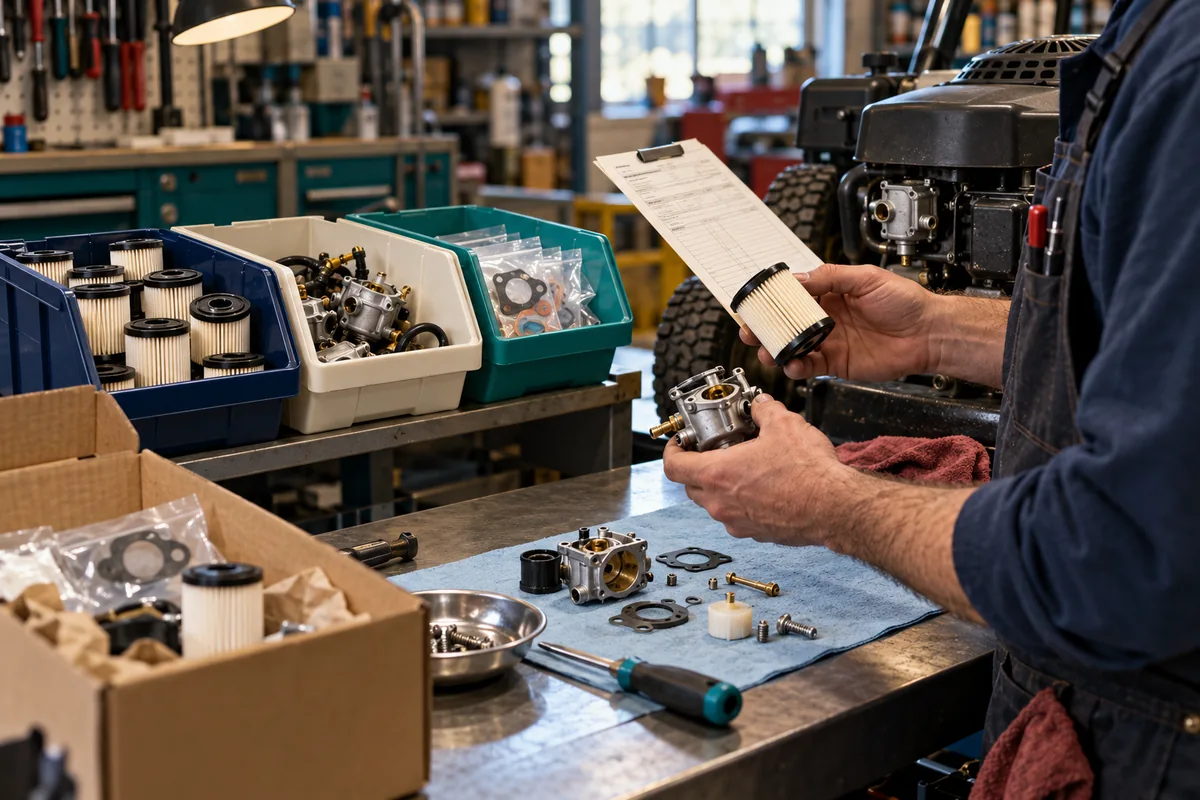
Repair-shop inventory is easiest to trust when every part has a location and every movement has a reason. A technician may reserve a carburetor kit for a mower without removing it from the shelf. Another job may consume one today; a returned part may or may not be sellable. Record those events separately so “on hand” does not get mistaken for “available for a new repair.”
Build a small parts catalog
Start with a stable SKU or manufacturer part number, description, compatible equipment, unit of measure, storage bin, supplier, unit cost and minimum stock rule. Keep near-identical parts separate when fit differs. For one-off customer-supplied parts, mark ownership clearly; they are not shop stock available to other jobs.
Record each movement once
For a fictional filter kit FK-12, the shelf begins Monday with 12 units. Four are reserved for work orders WO-201 and WO-202. The team receives 6 units, issues 3 to completed jobs and finds 1 damaged during count. The physical on-hand quantity becomes 12 + 6 − 3 − 1 = 14. If all four reservations were still open, available stock would be 14 − 4 = 10. In practice, release or reduce a reservation when its job consumes the part; do not subtract the same three units twice. This example assumes the four open reservations are for other jobs.
| Date | Part | Event | Quantity | Work order / reference | On hand after event |
|---|---|---|---|---|---|
| Mon | FK-12 | Opening count | 12 | Count C-01 | 12 |
| Tue | FK-12 | Received | +6 | PO-44 | 18 |
| Wed | FK-12 | Issued to jobs | −3 | WO-198/199 | 15 |
| Thu | FK-12 | Damaged adjustment | −1 | Count C-02 | 14 |
Reservations belong in a separate column with job IDs, quantities and release dates. A purchased part still on order is incoming, not on the shelf. A part placed in a customer’s machine has been issued and should be tied to that job’s cost and invoice check.
Reconcile the work order and the bin
At job close, compare the parts actually used with the estimate and invoice. If a repair was canceled, release its reserved parts. If a new part was returned unused, inspect it before adding it back to sellable stock. If a part failed in service, keep a separate warranty or scrap movement. A weekly cycle count of busy bins catches missed issues while the job is still easy to identify.
For replenishment, estimate demand during supplier lead time and a chosen safety allowance. If FK-12 uses three kits a week, lead time is two weeks and the shop selects two kits of safety stock, the illustrative reorder point is 3 × 2 + 2 = 8 units of inventory position. Compare on hand plus confirmed incoming less backorders with that point; the reorder-point guide explains the assumptions. A slow, expensive specialty part may be ordered per job instead of held in a bin.
The RepairBench OS guide and product preview let you evaluate the actual work-order and parts workflow. Check whether its current demo handles each movement you need. This ledger is a process example, not a claim that the app automatically syncs purchases or deducts parts.
Common questions
Is reserved stock still on hand? Yes, until physically issued, but it is unavailable to promise to another job.
When should a part hit job cost? Tie the actual issue to the work order and check the invoice; your accounting policy determines formal recognition.
Should I reorder every low-count part? Check open purchase orders, lead time, current jobs and demand before placing another order.
Connect the parts ledger to purchasing and customer work
Use the small-business order tracking guide to assign a next action to each customer job. Check replenishment assumptions with the reorder-point worked examples, and compare agreed purchase terms with the supplier quote comparison. These records serve different purposes: a job status does not prove that stock moved or a supplier was paid.
Before expanding the workshop, compare job hours and cash in the small-engine repair business plan.
Close a reservation without deducting stock twice
Use a separate sample to test the boundary between a reservation and a physical issue. The shop begins with 10 air filters, reserves three for WO-310 and two for WO-311, then receives four more. Physical stock is 14, open reservations are five, and available stock is nine. WO-310 then consumes its three filters. Physical stock falls to 11 and its three-unit reservation closes; the remaining two-unit reservation means available stock is still nine. Subtracting the consumed quantity from stock while retaining all five reservations would incorrectly show only six available.
| State | Physical stock | Open reservations | Available |
|---|---|---|---|
| After receipt | 14 | 5 | 9 |
| After WO-310 issue and reservation closure | 11 | 2 | 9 |
| WO-311 canceled; its hold released | 11 | 0 | 11 |
A cancellation releases a hold; it does not create a receipt. If one unused filter physically returns from WO-310 and passes the shop's condition review, record a one-unit return against that work order. Physical and available stock become 12. If the filter is damaged, retain it in the appropriate non-sellable record instead. Record each transition and its reference once.
Match the parts issue to the final job
At an illustrative $8 unit cost, the original three-filter issue totals $24. A valid one-filter unused return reduces net consumption to two filters, or $16 under this simple unchanged-cost assumption. Check the final work-order cost and customer invoice against actual usage. Inventory, billing and formal accounting can have different rules; a corrected stock count is not permission to change an invoice silently.
Make these events part of a weekly exception review: issued parts with no job ID, canceled jobs with active reservations, unexplained positive adjustments and returned parts awaiting inspection. If workshop instruments also affect service decisions, keep their evidence in a separate equipment calibration log; parts stock does not prove a measuring instrument is suitable for use.