
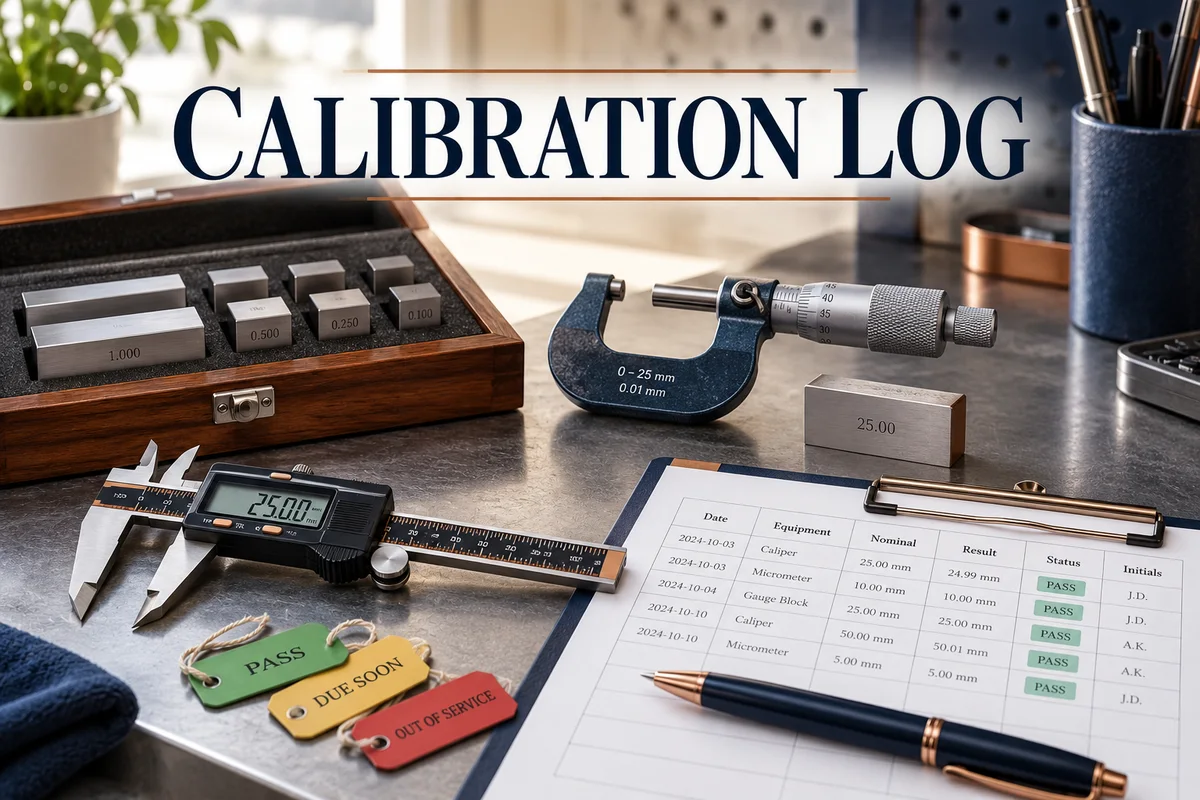
An equipment calibration log connects each measuring instrument to its calibration history, evidence and next review. A due-date list tells you when to act; an event record tells you what happened. Keep both, joined by a stable instrument ID.
This guide provides an original CSV starter and a fictional workshop example. It explains record organization, not how to calibrate an instrument or approve its use. The acceptance criteria and authority for those decisions belong to your controlled procedure and qualified personnel.
Download the free calibration log starter CSV
The file contains three labeled sample rows, no macros or formulas. It opens in ordinary spreadsheet software. The paid CalibraTrack application is a separate offline HTML product.
Keep the instrument register separate from event history
Use one register row per physical instrument. If you have two identical calipers, assign two IDs and retain their serial numbers. A model name alone cannot identify which instrument was checked, repaired or used on a particular job.
| Field | Example | Purpose |
|---|---|---|
| Instrument ID / serial | CAL-014 / sample SN-014 | Link the physical instrument to its records |
| Type / range / location | Digital caliper / 0–6 in / inspection bench | Identify use and whereabouts |
| Responsible owner | Quality lead | Assign review and service follow-up |
| Interval rule / basis | 180 calendar days / procedure QP-07 | Document the approved scheduling assumption |
| Last accepted event / due date | April 6 / October 3, 2026 | Maintain a reviewable deadline |
| Current status / evidence reference | Due today / certificate CERT-014-A | Show what needs action and where evidence lives |
Keep each later calibration in a separate event row with its own event ID, actual service date, provider, certificate reference, result, reviewer and review date. Updating the register must not erase an earlier failed result. Document corrections with the previous value and reason instead of rewriting history without explanation.
Calculate the next due date from the documented rule
NIST's calibration-interval guidance does not prescribe a universal recalibration interval. Requirements and instrument behavior matter. A calendar in a planning tool is a way to apply an approved rule, not evidence that the rule is suitable.
In this fictional example, procedure QP-07 specifies 180 calendar days after an accepted calibration on April 6, 2026. Adding 180 days gives October 3, 2026. On October 1 the due date is two days away. On October 3 it is due today; on October 4 it is one day overdue. Those labels do not independently authorize operation.
If the procedure instead uses six calendar months, April 6 plus six months is October 6. That is a different rule. Do not substitute 180 days for six months, or use the day the certificate arrived if the procedure requires the service date. Explicitly record the trigger, units, interval and any approved exceptions.
In a spreadsheet, a day-based rule can use Next due = accepted calibration date + interval in days and Days to due = next due date − review date. Keep blank or unverified dates as “Needs review.” A spreadsheet default date should never turn missing information into a reassuring green status.
Review the certificate as well as the calendar
Check that the evidence belongs to the correct instrument and service event. Locate the relevant measurement results, test conditions and stated uncertainty where required by your procedure. Record who reviewed them against the acceptance criteria; a certificate filename alone is not an acceptance decision.
NIST's metrological traceability policy describes a documented calibration chain to a reference and explains that traceability alone does not guarantee suitability for a measurement need. “NIST traceable” in a spreadsheet cell is not a replacement for the supporting evidence.
- Match instrument ID, serial number and service date to the register.
- Keep the provider's certificate identifier and an accessible document reference.
- Record the review outcome, reviewer and outstanding questions.
- Update the next due date only through the approved scheduling process.
A document reference can point to an internal controlled folder. Test access using the person who needs the record; do not assume a path on one employee's computer is available to everyone. Protect the original certificate separately from the editable scheduling sheet.
Keep an out-of-tolerance event open until reviewed
Suppose CAL-014 returns from service with an out-of-tolerance finding. Log event OOT-014-01 and notify the responsible reviewer. Record the relevant service report, the last known acceptable check, the suspected use period and references to any affected-use investigation. Do not infer that all earlier measurements were wrong, or that a repair automatically resolves their impact.
| Action | Owner | Evidence / decision |
|---|---|---|
| Identify the instrument's operational restriction | Quality lead | Status and physical identification under procedure |
| Locate relevant jobs and measurements | Process owner | Job IDs and investigation reference |
| Review impact and corrective action | Authorized reviewer | Documented determination, not a guessed outcome |
| Record return-to-service decision | Authorized person | Accepted evidence, approval and date |
Keep a scheduling status distinct from an operational restriction. An instrument can have a future due date and still be unavailable because it was damaged. A missing certificate, unresolved result or open impact review deserves a next action and owner even when the calendar looks current.
Run a short weekly review and protect the records
- Check overdue items, upcoming due dates and records with no verified date.
- Confirm the service appointment and instrument availability before promising work.
- Review missing certificates and unresolved findings separately.
- Check completed service evidence before closing an action.
- Save a dated backup and periodically test recovery in a separate workspace.
For example, if three instruments are due this month and two require external service, book their handoffs around the work that needs them. Measure actual turnaround from dispatch to accepted return rather than just the provider's promised delivery date. The supplier scorecard guide shows how to keep denominators and missing data visible.
CalibraTrack OS organizes an instrument register, due schedule, event and certificate references, out-of-tolerance follow-up and service history. Its setup and workflow guide covers the actual fields and JSON backup process. Records stay in the local browser; the app does not certify compliance or make acceptance and return-to-service decisions.
Questions to resolve before using the starter
Is the log a calibration certificate? No. It indexes events and evidence; the service report and review remain separate. Can every instrument use the same interval? Do not assume that. Document the applicable rule per instrument or controlled group. Does “overdue” prove an instrument is inaccurate? It identifies a missed scheduling deadline. The response and permitted use must follow the relevant procedure.