
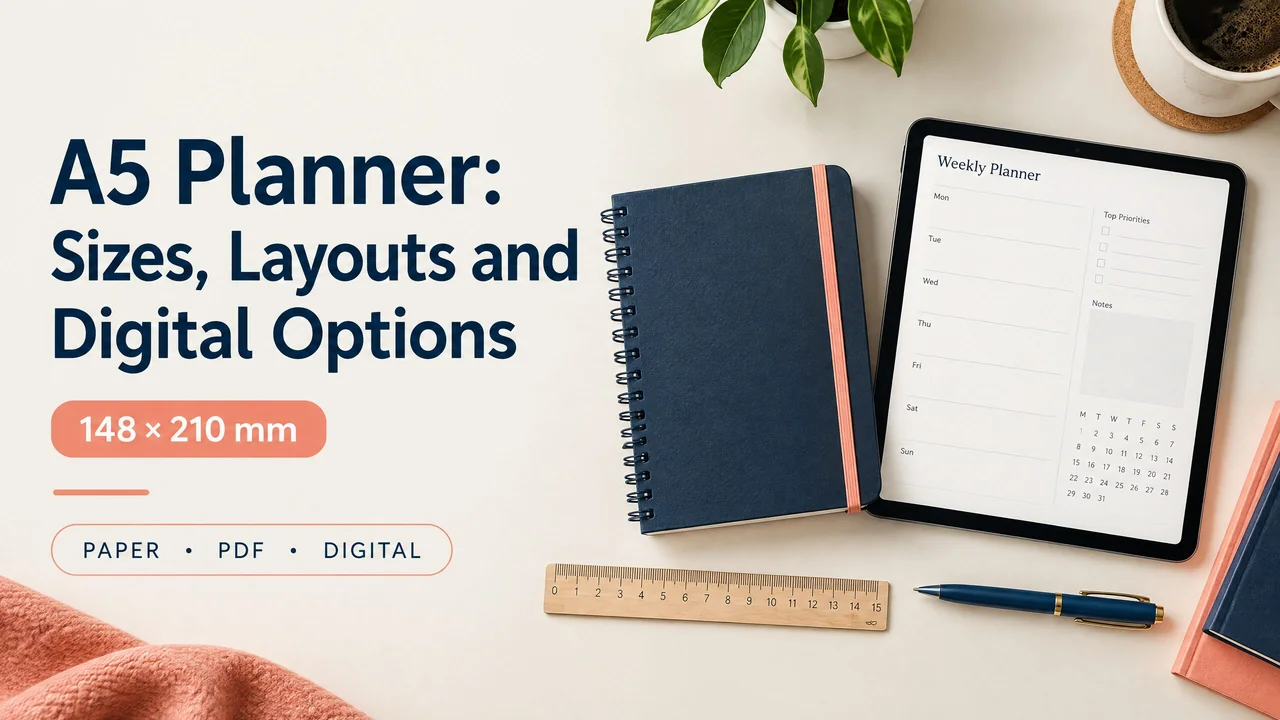
Quick answer: common planner sizes include A6 (105 × 148 mm), A5 (148 × 210 mm), Half Letter (5.5 × 8.5 inches), US Letter (8.5 × 11 inches), A4 (210 × 297 mm), and discbound Classic (7 × 9.25 inches). A5 and Half Letter are not identical. Before buying refills or printing planner pages, measure the paper, then check the hole pattern and print scale. This guide compares the formats side by side with a practical US home-printer workflow.
Planner sizes chart: inches and millimeters
Planner pages and covers often use the same size name for slightly different products. The dimensions here describe nominal page size, not outer binder dimensions. Inches for metric standards are approximate; verify a seller's exact trim size and hole positions before purchasing inserts.
| Planner paper format | Size in inches (W × H) | Size in millimeters (W × H) | Typical role |
|---|---|---|---|
| A6 (ISO) | 4.13 × 5.83 | 105 × 148 | Pocketable notes, short daily lists |
| Personal ring (common) | 3.75 × 6.75 | 95.3 × 171.5 | Slim ring inserts; not the same as A6 |
| A5 (ISO) | 5.83 × 8.27 | 148 × 210 | Portable daily, weekly and study layouts |
| Half Letter / Junior | 5.5 × 8.5 | 139.7 × 215.9 | Half a US Letter sheet; popular disc inserts |
| B5 (ISO) | 6.93 × 9.84 | 176 × 250 | Roomier notes and work planning |
| B5 (Japanese JIS) | 7.17 × 10.12 | 182 × 257 | Some Japanese school notebooks |
| 7 × 9 | 7 × 9 | 177.8 × 228.6 | Mid-size desk planner; not 7 × 9.25 |
| Classic discbound | 7 × 9.25 | 177.8 × 234.95 | Some Classic refill systems |
| US Letter | 8.5 × 11 | 215.9 × 279.4 | Full page, common in United States |
| A4 (ISO) | 8.27 × 11.69 | 210 × 297 | Full page in many other countries |
Most useful distinction: a nominal page dimension does not define binder compatibility. For example, an A5 six-ring insert and an A5 discbound insert can share paper dimensions but cannot use the same holes.
For independent reference tables, compare the published Function of Planning size guide, Cloth & Paper size guide and paper-size standards comparison. Individual brand measurements and binding patterns can vary.
A5 vs Half Letter: why near-equal planner sizes do not always fit
A5 paper measures 148 × 210 mm; Half Letter measures 139.7 × 215.9 mm. So A5 is about 8.3 mm wider and 5.9 mm shorter. The difference matters near binder rings, tabs, page dividers and printed margin guides.
| Question | A5 | Half Letter |
|---|---|---|
| Works with standard office stock? | An A4 sheet folded/cut in half | A US Letter sheet folded/cut in half |
| Common home-paper source | A4 in international markets | US Letter in North America |
| Usable page area | Slightly wider and shorter | Slightly narrower and taller |
| Can I reuse the same punches? | Not unless the actual binder mechanism and punch positions match | |
If you mainly plan at a desk and print at home in the United States, Half Letter may be simpler because your printer already accepts Letter paper. If you carry a planner daily and use A-series supplies, A5 is a practical midpoint. For details specific to A5 planning layouts and digital formats, see our A5 planner guide.
Binder compatibility: page size, holes and cover are three separate checks
A size chart answers how large the sheet is; it does not guarantee that it fits the rings or discs. Before ordering a replacement pack, check all three:
- Paper dimensions: measure an existing insert with a ruler in millimeters, including the cut-edge width and height.
- Punch pattern: count the rings or discs, and compare the distances between hole centers. A5 six-ring, A5 discbound and Half Letter eight-disc are distinct systems.
- Tabs and usable margins: some divider tabs stick out past the printed page; a page can fit the binder but block the zipper or cover edge.
Common naming traps
- A6 vs Personal: many marketplaces use “A6 binder” loosely. True ISO A6 is 105 × 148 mm, while common Personal ring pages are around 95 × 171 mm. These cannot be assumed interchangeable.
- 7 × 9 vs 7 × 9.25: a quarter inch of extra height affects refill and divider fit.
- B5 ISO vs JIS: these standards have different dimensions, so check whether the listing is Japanese or ISO B5.
- Cover size vs refill size: outside cover dimensions may be larger because of material thickness, rings or stitching.
Vendor guidance may describe near-sized inserts as interchangeable in particular covers. Treat that as model-specific, not a guarantee for all binders.
How to print planner inserts at the correct size at home
The most common preventable mistake is using “Fit to page” when a PDF already has the intended size. A printer may enlarge, shrink or center the design incorrectly. Follow this seven-step test before printing the whole planner.
- Open the printable file and check its document page size (for example, Letter, A4 or A5). Do not judge from the on-screen zoom level.
- Choose a physical paper size that your printer supports; in a US home office this is often US Letter, 8.5 × 11 inches.
- In the print dialog, select Actual size / 100% if the PDF is already configured for the paper or insert you need. Avoid automatic scaling unless you intentionally change formats.
- If printing two smaller inserts on one sheet, use a properly prepared two-up layout. Do not assume the printer's “two pages per sheet” mode gives cut or punch margins.
- Print one trial page; measure the printed outline and compare with the table above. If a design includes a ruler, check that a printed 1-inch line really measures 1 inch.
- Leave safe space beside the binding edge and trim using the intended cut marks. Your printable must actually contain adequate crop and hole margins.
- Test the page inside the binder before printing a full year. Verify that rings close cleanly and the page turns without dragging.
Worked example: you want a 5.5 × 8.5-inch Half Letter page but have only US Letter (8.5 × 11-inch) paper. A properly laid out two-up design can fit two Half Letter pages on one landscape-oriented US Letter sheet. One careless “Fit to printable area” selection might shrink both pages: measure the sample before cutting.
Our free Printable Planner Builder can help you test a customizable planner layout; inspect the available page sizes and print options in the tool rather than assuming a particular insert is supplied. For ready weekly structure, see the free weekly planner template.
Which planner size should you choose for your planning routine?
Choose in this order: what goes on the page → where you use it → available paper → exact binding. Your weekly layout will fail if the cells are too small, even if the cover looks attractive.
| Use case | Good starting size | Trade-off |
|---|---|---|
| Carry just today's appointments | A6 or Personal | Small writing space; watch ring-system labels |
| Student assignments and weekly notes | A5 or Half Letter | Enough room for a weekly spread; may need a separate detailed study page |
| Busy workday with time blocks | Half Letter, A5 or 7 × 9 | More space helps when tracking hour-by-hour blocks |
| Desk-based project, teacher or business tracking | US Letter or A4 | Readable tables but less portable |
| Printable system with replaceable pages | Match existing binder size exactly | Binder/punch fit matters more than a nominal size name |
If you need an hourly planning page, the hourly planner guide compares formats. If you work mostly on a screen, paper size may matter less than digital planner compatibility, data saving and backup. The best fit is the smallest size that still gives you the writing area your real week requires.
A simple fit test before purchasing inserts
Take one sheet of ordinary paper, draw an outline matching the size you are considering, and sketch a real week: three fixed appointments, five tasks and one notes block. Cut the outline and hold it inside your existing cover. If you cannot read or write comfortably at that scale, move up one size before buying a year's worth of refills. This test is more reliable than judging size from a product photo.
Frequently asked questions about planner sizes
What are the most common planner sizes in the United States?
US Letter (8.5 × 11 inches) and Half Letter (5.5 × 8.5 inches) are easy to print from standard US office paper. A5 and 7 × 9-inch formats are also common for bound or insert-style planners; exact compatibility varies by product.
Is A5 the same as Half Letter?
No. A5 is 148 × 210 mm and Half Letter is approximately 139.7 × 215.9 mm. Some covers can accommodate both, but a refill's paper and hole pattern still need checking.
Is A4 larger than US Letter?
A4 is slightly narrower and taller. A4 is 210 × 297 mm; US Letter is 215.9 × 279.4 mm. Printing an A4 PDF on Letter paper without reviewing scaling can change margins or crop details.
Does a 7 × 9 planner fit Classic 7 × 9.25 inserts?
Do not assume it does. The height differs by 0.25 inch and the punch pattern might differ. Check the measured inserts and the actual binder specification.
Which size is best for printable daily planner pages?
Use A5 or Half Letter when you want portable daily planning. For large time-block tables, teacher lessons or detailed projects, a full Letter or A4 page may be easier to read and write on.
Do digital planners need a paper size?
A PDF planner still has a document/page size, which matters when printing or handwriting on a tablet. An adaptive browser-based planner is usually designed around the screen rather than paper dimensions; check actual export and print behavior before buying.