
FREE · NO ACCOUNT NEEDED
Trucking Trip Cost Worksheet
Calculate a trip cost using loaded and empty miles, fuel and your maintenance allowance. Compare total-mile economics and entered payment dates.
Enter your own assumptions, calculate and keep a backup. Load the fictional example to see a filled-in report.
Set up your worksheet
Your report
Enter your details, then calculate to review results.
Save or download your work
Work stays in this page until you choose Save on this device. Device saves belong to this browser and can be removed by clearing browser data. JSON keeps an editable backup; CSV and PDF keep a report.
Trucking Trip Cost Worksheet: complete guide
What this worksheet does
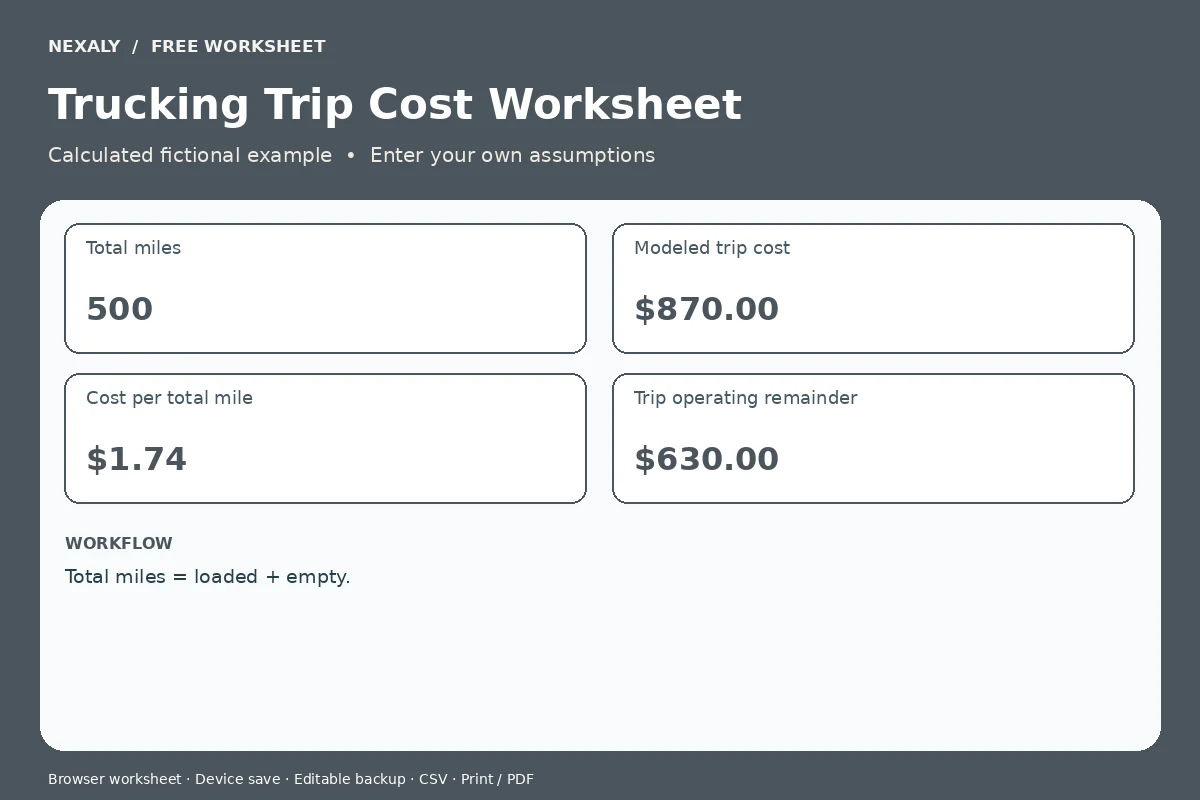
Total miles = loaded + empty. Fuel cost = total miles ÷ mpg × fuel price. Modeled trip cost includes fuel, maintenance allowance and entered nonfuel costs. Cost/mile always uses total miles. Allowances and fixed allocations are not necessarily cash paid on this trip. The report dates only entered nonfuel payments, not fuel or maintenance cash timing.
Keep up to 100 editable entries. The worksheet runs in your browser and does not send its entries to another service. The calculations use the inputs you provide; currency selectors label amounts without conversion.
How to use it
- Set a descriptive worksheet name and complete the settings for your planning period.
- Add one entry per record. Use consistent units and keep the evidence behind your assumptions.
- Calculate and inspect the report, including any review notes. Change an input and calculate again to replace the old result.
- Save an editable backup before changing a scenario. Use the related guide below for the wider operating workflow.
Inputs and units
| Field | Rule |
|---|---|
| Worksheet name | Required for calculation. Up to 160 characters. |
| Currency | Required for calculation. Choose USD, GBP, CAD, AUD, EUR, NZD. |
| Loaded miles | Required for calculation. 0–1000000; up to two decimal places. |
| Empty miles | Required for calculation. 0–1000000; up to two decimal places. |
| Trip revenue excluding pass-through tax | Required for calculation. 0–1000000; up to two decimal places. |
| Expected miles per gallon | Required for calculation. 0–100; up to two decimal places. |
| Fuel price per gallon | Required for calculation. 0–1000000; up to two decimal places. |
| Maintenance allowance per total mile | Required for calculation. 0–100; up to two decimal places. |
| Expected customer collection date | Required for calculation. Valid calendar date, 1900–2200; no timezone shift. |
| Nonfuel trip cost | Required for calculation. Up to 160 characters. |
| Cost amount | Required for calculation. 0–1000000; up to two decimal places. |
| Cash payment date | Required for calculation. Valid calendar date, 1900–2200; no timezone shift. |
Calculation and scope
Total miles = loaded + empty. Fuel cost = total miles ÷ mpg × fuel price. Modeled trip cost includes fuel, maintenance allowance and entered nonfuel costs. Cost/mile always uses total miles. Allowances and fixed allocations are not necessarily cash paid on this trip. The report dates only entered nonfuel payments, not fuel or maintenance cash timing.
Unit-based cost components are rounded to cents individually, with half-cent ties rounded up. For example, 2.01 hours at $0.50 per hour produces a rounded $1.01 cost.
Fictional worked example
Load the fictional example to reproduce this report. The sample is an original illustration, not a customer result or a market benchmark. The dollar figures below use USD.
| Result | Sample value |
|---|---|
| Total miles | 500 |
| Modeled trip cost | $870.00 |
| Cost per total mile | $1.74 |
| Trip operating remainder | $630.00 |
| Nonfuel cost | Amount | Entered cash date |
|---|---|---|
| Driver cost | $300.00 | 2026-10-16 |
| Tolls | $50.00 | 2026-10-16 |
| Fixed operating allocation | $100.00 | 2026-10-16 |
Consistent trip economics
| Measure | Value |
|---|---|
| Loaded miles | 400 |
| Empty miles | 100 |
| Expected fuel gallons | 80 |
| Modeled fuel cost | $320.00 |
| Maintenance allowance | $100.00 |
| Nonfuel entered costs | $450.00 |
| Revenue / total mile | $3.00 |
| Revenue / loaded mile | $3.75 |
| Expected collection date | 2026-10-30 |
Entered nonfuel payments before collection
| Cost | Cash date | Amount |
|---|---|---|
| Driver cost | 2026-10-16 | $300.00 |
| Tolls | 2026-10-16 | $50.00 |
| Fixed operating allocation | 2026-10-16 | $100.00 |
Save, restore and export
Save on this device writes an explicit save to this browser; it does not download a file or sync across devices. Clearing browser storage can remove it. Download backup keeps an editable JSON file for this exact worksheet. Import previews the backup before replacing current entries; save again if you want to replace the device save. CSV contains the calculated report, not an editable import format. Print / Save PDF opens the browser print dialog; choose Save as PDF where available.
Questions and limits
Is the example my result?
No. It is fictional data. Replace its assumptions with your own records, then calculate again.
Does saving share my worksheet?
No. Device saves belong to this browser. Move an editable worksheet with its JSON backup and keep sensitive information out of a shared device.
Does a report establish that my plan is correct?
No. Arithmetic can be consistent while the input assumptions are wrong. Keep evidence, review the scope described above and check any decisions against your real records.
Continue the workflow
Equipment Rental Business Plan Example: Utilization and Cash. Trucking Company Business Plan: Total-Mile Cost Example.
Compare fuel price and empty-mile scenarios
These are separate fictional changes to the 500-mile sample, not current market rates. At $4.50 per gallon instead of $4.00, 80 gallons cost $360: total modeled cost becomes $910 and the $1,500 trip leaves $590. Reset fuel to $4.00, then increase empty miles from 100 to 150. Total distance becomes 550 miles; fuel costs $352, maintenance allowance is $110 and other entered costs stay $450. Total cost is $912, leaving $588. Review whether driver, toll and fixed allocations also need to change before using that second scenario.
Choose your next planning step
- equipment maintenance due planner: Check entered service intervals alongside the trip cost allowance.
- invoice collection schedule: Follow up the expected receipt separately from the trip operating remainder.
Plan beyond one trip
Review Small Business Planner 2026–2028 for the documented wider business-planning workflow around your trip assumptions. Small Business Planner 2026–2028 — Goals, Finance & Operations. Paid products are separate; the free JSON backup is not a paid-product import file.