

This small-business balance-sheet template records assets, liabilities and equity at one reporting date. Download the Excel workbook for a clean sheet and a fictional filled example, or use the printable PDF. The example reconciles $15,000 assets = $6,000 liabilities + $9,000 equity without using equity as an automatic balancing figure.
Download the balance-sheet workbook
Download the Excel template: blank and filled example · Download the printable PDF
The workbook has two tabs, Blank and Filled example. Yellow amount/header cells are editable. Formulas calculate totals, the difference and a balance status only when the required inputs are complete. The PDF has a static blank page and completed example; it does not calculate or contain fillable form fields. No native Google Sheets copy link is provided.
A balance sheet is a dated snapshot
The SEC's financial-statements guide explains the accounting relationship between assets, liabilities and equity and distinguishes a balance sheet from period-based income and cash-flow statements. Use one reporting date and a consistent basis for the figures entered here.
Do not put a year's receipts into the cash balance field or treat an unpaid invoice as bank cash. Use reconciled records for the amounts your business actually reports. The template's simplified account rows are a starting structure, not a complete chart of accounts for every entity.
How to fill in the Excel template
- Save a working copy. Keep the clean download, duplicate the Blank tab if needed and give the working file a dated name.
- Enter the business, reporting date, currency and basis. Currency labels do not convert values. Describe the actual basis and scope rather than copying the fictional example.
- Enter each asset balance from its record. Use the bank reconciliation for cash and the appropriate ledger or schedule for receivables, inventory and equipment. Enter accumulated depreciation as a positive deduction from equipment cost.
- Enter liabilities without double-counting debt. Put the current portion in its own row and only the remaining long-term amount in the long-term row. Include other applicable obligations in the supported category or adapt the statement with your accountant.
- Enter equity from its supporting records. Contributed capital and earnings are not invented from the difference. Retained losses and other equity adjustments may be signed. Owner withdrawals are a positive deduction only where that presentation fits your records.
- Complete the inputs and read the checks. Enter numeric zero for an amount that genuinely does not apply. Resolve missing values, text amounts, excess fractional cents or unsupported negative amounts. Source-reference fields help trace entries but are not verified automatically.
Keep the calculated cells intact. The current input rows are fixed; inserting accounts or changing formulas requires a fresh review of the ranges and totals. This sheet does not import transactions or create journal entries.
The filled $15,000 balance-sheet example
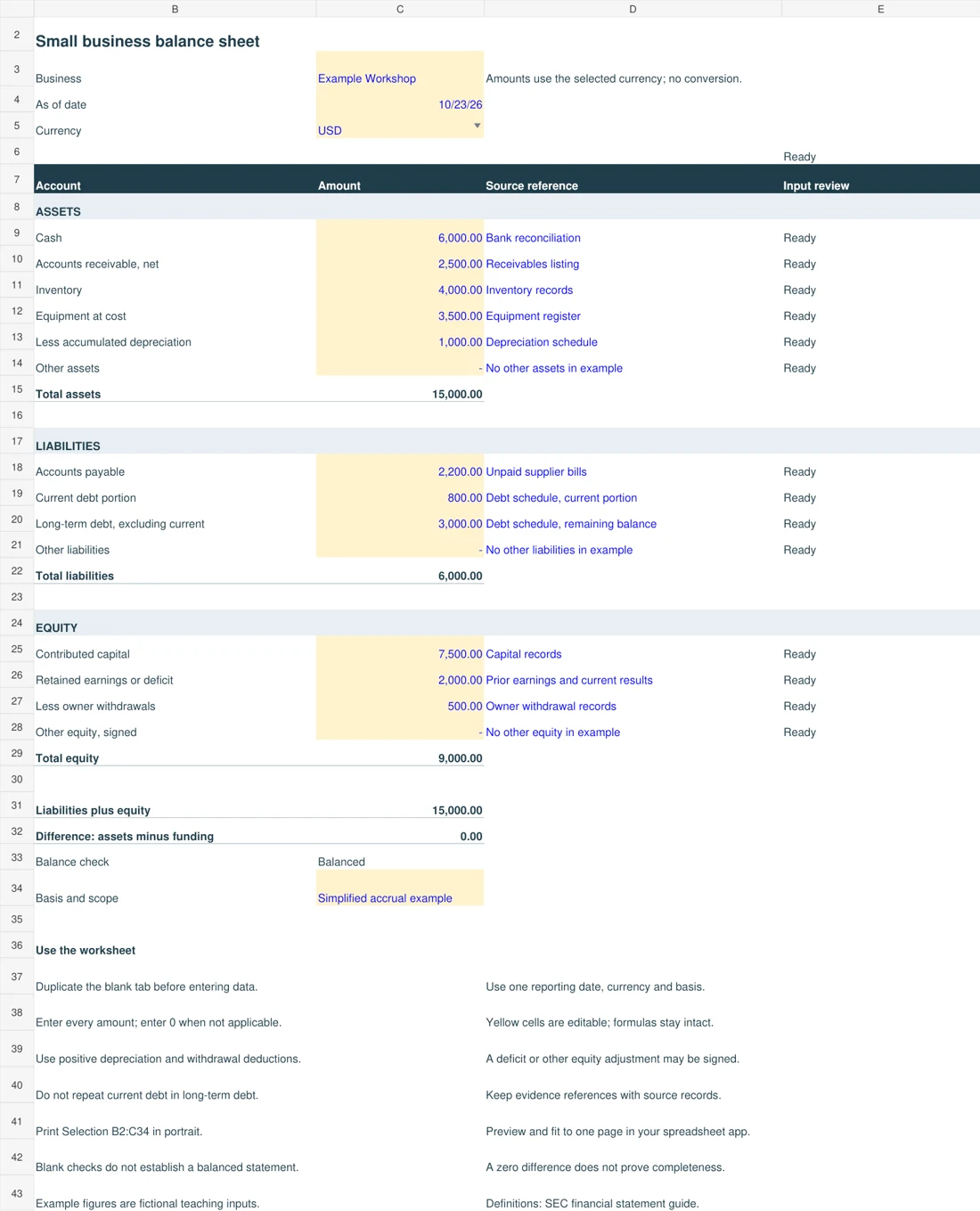
Example Workshop is fictional. Its October 23, 2026 snapshot uses a simplified accrual example in USD. None of the amounts describe a customer or your business.
| Section | Entered balances | Total |
|---|---|---|
| Assets | Cash 6,000 + receivables 2,500 + inventory 4,000 + equipment cost 3,500 − accumulated depreciation 1,000 + other assets 0 | $15,000 |
| Liabilities | Accounts payable 2,200 + current debt 800 + remaining long-term debt 3,000 + other liabilities 0 | $6,000 |
| Equity | Contributed capital 7,500 + retained earnings 2,000 − owner withdrawals 500 + other equity 0 | $9,000 |
Liabilities plus equity total $15,000. The workbook's difference is assets minus that total, so it displays 0.00 and Balanced for the restored example. Retained earnings are an independently entered $2,000 teaching balance; they are not calculated as the unexplained remainder.
Check whether withdrawals are already included in the equity balances you bring from your ledger. If they have already reduced the supplied closing balance, subtracting them again would double-count the reduction. Your entity's accounts and presentation may require different equity rows.
Use the $100 mismatch test
In a disposable copy of Filled example, change cash from $6,000 to $6,100 and leave the other inputs unchanged. Assets become $15,100, while liabilities plus equity remain $15,000. Difference becomes $100 and the status changes to Check difference. Restore cash to $6,000 before using or sharing the example.
For a real discrepancy, compare each entered balance to its source, confirm the cutoff date, inspect omitted or duplicated accounts and review signs. Do not enter an unexplained equity adjustment merely to make the difference zero. A sheet can balance even when an account is missing from both sides or an amount is assigned to the wrong category.
A paired change can remain in balance
The separate $1,000 principal-payment test changes cash to $5,000 and remaining long-term debt to $2,000. Assets become $14,000, liabilities $5,000 and equity stays $9,000. The statement still balances. Keep the payment in the cash forecast on its actual date; interest and other effects need their own records. This is a simplified teaching transaction, not an instruction to classify a real payment without its loan statement.
Balance sheet, budget, profit or cash flow?
| Record | Main planning question | Related guide |
|---|---|---|
| Balance sheet | What balances are reported at this date? | This workbook and its source records. |
| Budget and variance | How do planned and actual operating amounts compare for a period? | Monthly budget review. |
| Cash forecast | When are receipts and payments expected? | 13-week cash forecast. |
| Profit-and-loss statement | What revenue and expenses belong to the period? | Use the appropriate reconciled accounting report; this workbook does not calculate it. |
A cash total alone does not explain profit or the outstanding debt. Keep each report's date, basis and scope clear before comparing it with another record. The files are separate and do not synchronize.
Save, reopen and print the correct range
Keep the working file in .xlsx format so the formulas remain present. Save and reopen a test copy, change cash by $100 and confirm that the difference reacts. For a recipient-facing workbook print, select B2:C34 on the desired tab, choose Print Selection, portrait orientation and fit to one page. Source references and internal input reviews remain outside that selection. Inspect the print preview before sending.
The PDF uses US Letter portrait pages: page one is blank and page two is the filled example. Print only the needed page. Other paper sizes may require scaling. Native Excel/Sheets recalculation, phone use and printer output still need checking in the application you plan to use; no compatibility certification is implied by the preview.
Scope and accounting review
This is a simple educational template. It does not certify GAAP/IFRS compliance, value a business, calculate tax, audit balances or satisfy a particular lender's filing requirements. It does not calculate depreciation, close earnings into equity or determine the correct classification for a real account. Have the accounts, basis and required presentation reviewed by a qualified accounting professional before using it for consequential reporting.
For goals and wider operating planning, review the documented features of the Small Business Planner and its user guide. That is a separate paid product; this free workbook is not advertised as its import format.
Customer deposit example (simplified accrual-basis illustration): Suppose a customer pays $500 in advance for work the business has not yet delivered. When the money is received, cash increases by $500 and a corresponding $500 customer-deposit liability is recorded; equity does not increase merely because the bank balance went up. When the obligation is later fulfilled, the accounting treatment changes based on the actual agreement and applicable accounting rules. This example is not a substitute for an accountant’s classification of customer advances, taxes or revenue recognition.
Frequently asked questions
Why are the totals blank on a fresh sheet?
Required header or amount inputs are incomplete. Enter every required balance, including intentional zeros, and inspect the input-review column. A blank sheet should not display a healthy zero balance.
Does Balanced mean my accounts are correct?
No. It only means the entered amounts reconcile under this worksheet's model and checks. Review completeness, classifications and evidence separately.
Can I enter a retained loss?
The retained earnings/deficit row accepts a signed amount. Other inputs have specific sign rules; use your source records and accountant's presentation rather than changing signs to force a tie.
Can I use Google Sheets?
No native copy link is provided. If you import the .xlsx file into another spreadsheet application, test formulas, date handling, warnings, saving and printing before relying on it. Native-app verification remains open.
Does changing USD convert the amounts?
No. The selector identifies the currency of numbers you already entered. It does not apply an exchange rate.