
Free printable caregiver daily log and handoff
This two-page PDF contains a blank daily coordination sheet and a fictional filled example. Use it for agreed tasks, factual observations, responsibility and the next handoff. The editable text template remains available below.
Choose US Letter or A4, print at actual size and check the page preview. Keep completed records in the place agreed with the person receiving care. The example covers meals, transport and household coordination; it does not supply clinical instructions or medication doses.
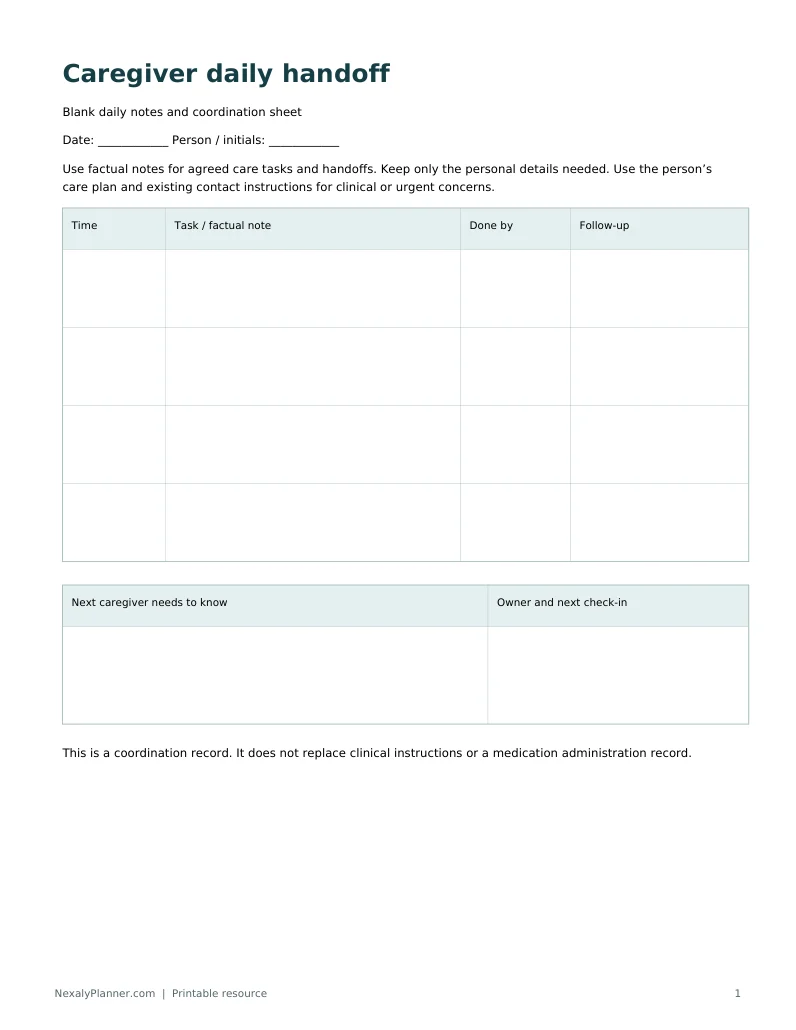
A caregiver daily log helps the next person understand what happened and what still needs attention. Record the time, the person completing the task and the next responsible person. Keep observations separate from explanations of their medical cause. This page is a family coordination worksheet, not a clinical chart or treatment plan.
Download or copy the blank daily log
Download the editable caregiver daily log (.txt)
Open the plain-text file in a text editor or copy it into your own private document. It contains blank fields, not personal health records. Keep the original blank file and save a dated working copy. Add identifying information only in a place your care recipient and care team have agreed to use.
| Field | What to record |
|---|---|
| Date, time and caregiver | When the entry was made and who made it |
| Planned tasks | The task, scheduled time and responsible person |
| Completed tasks | What actually happened and at what time |
| Observations | Specific words or events without diagnosing a cause |
| Questions and contacts | Who was contacted, when and the response actually received |
| Open handoff | The next action, named owner and time to revisit it |
| Handoff acknowledged | Who accepted responsibility and when |
A filled, fictional handoff
On October 12, Maya plans to drive her parent to a 2:00 p.m. clinic appointment. At 11:40 a.m., the parent says the stairs feel more tiring than yesterday. Maya records the words and the time without labeling a diagnosis. She notes the appointment in the log and records any actual care-team instructions in the family's private record.
At 4:15 p.m., Maya adds: “Sam to confirm the next visit time by 6:00 p.m.; clinic scheduling number is in our private contact list.” Sam acknowledges the task at 4:30 p.m. After the call, he records the confirmed visit date and closes the scheduling item. If he cannot reach the clinic, the item stays open with the next call time. “Someone will call” is not a complete handoff.
Separate the plan from what happened
A scheduled appointment belongs in the plan. The actual departure and return times belong in completed tasks. An unanswered call belongs in open follow-up. Keeping those three states separate prevents the next caregiver from treating a plan as proof that the task was completed.
When a task changes, preserve the original entry and add a dated correction. For example: “Transport changed from Maya to Sam at 9:20 a.m.; Sam confirmed.” Do not silently overwrite an important handoff or fill in a completion time from memory as though it was observed.
Agree on access and a short review routine
The National Institute on Aging's guidance on sharing caregiving responsibilities recommends agreeing who handles each task and reviewing the arrangement as circumstances change. Use that conversation to decide who needs the log, where it is kept and who checks open items.
Before a handoff, review incomplete tasks, changed appointments and questions awaiting a response. The receiving caregiver should acknowledge the items they are taking on. Keep financial identifiers, full medical documents and other sensitive details in the appropriate private record rather than repeating them in every daily entry.
Record medication-related tasks only against the actual prescribed plan and care-team instructions; this worksheet supplies no dose or schedule. For an urgent change, follow the care plan and local emergency guidance rather than waiting for a routine log review. Do not enter identifiable health details in a public product demo.
Common questions
How long should a daily log be?
Long enough to show what happened, when, by whom and what remains open. A factual sentence and a clear next action are more useful than a long unreviewed account.
Can the log include a caregiver daily schedule?
Yes. Put expected tasks and appointments in the planned section, then record completion separately. If a different person takes over, update the task owner and confirm the handoff.
Is this a medical record system?
No. It is a family coordination example. Follow your professional care team's instructions and any applicable recordkeeping requirements.
When might a separate planner help?
If appointments, transport and family tasks are becoming hard to coordinate, inspect the Caregiver Planner for Aging Parents and its user guide. The paid app is separate from this free text worksheet. Try fictional records in the preview and check storage and backup instructions before choosing it.