
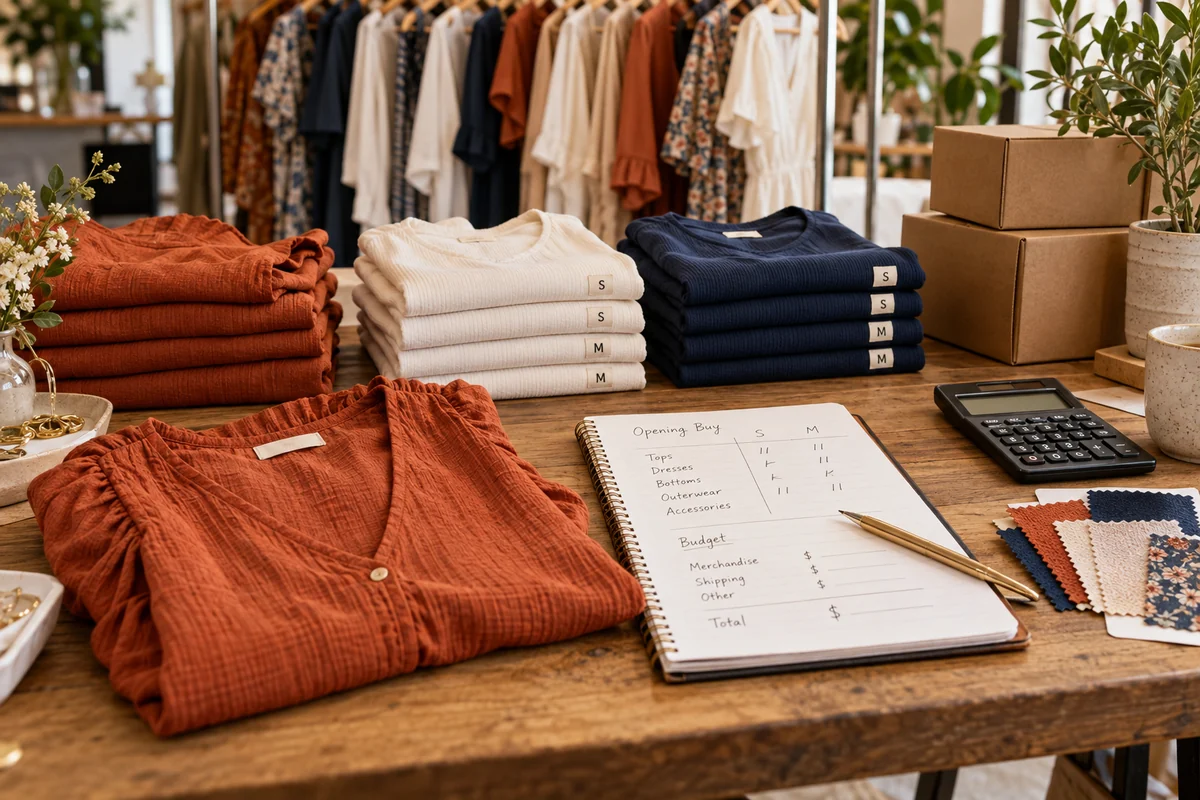
A new boutique does not need a magic number of pieces. It needs an opening assortment that fits the cash available, the size range customers can buy, the space available and a test period long enough to learn what sells. Start with a cash ceiling, set aside money for costs beyond the garments, then allocate units by style and size. The example below produces 120 units across 24 sellable variants for a fictional online clothing shop. It is a planning example, not a target for every boutique.
Step 1: Set a cash ceiling before counting units
Suppose an owner has $5,000 available for launch purchases and setup. She reserves $900 for shipping supplies, photography and a small first campaign, plus $600 for a reorder or unexpected freight bill. That leaves $3,500 for the opening merchandise order. She will not spend the reserve simply to add another color to a launch photo. Rent, taxes and other obligations would require their own allocation; this simplified example assumes they have already been handled outside the $5,000.
The purchase ceiling is cash, not a sales forecast. A projected $8,000 of retail value would not pay the supplier invoice due today. Record deposits and balance due dates separately if a vendor splits the payment. For a monthly spending view, see the small business budget example.
Step 2: Choose a narrow test assortment
The owner selects six styles, two colors per style and two sizes per color. That creates 6 × 2 × 2 = 24 variants. Five units per variant means 120 units. At an average landed cost of $22 per unit, the merchandise uses 120 × $22 = $2,640, leaving $860 of the $3,500 merchandise ceiling for freight differences, size swaps or a measured reorder. “Landed cost” here means the amount assigned to getting usable stock ready for sale; list the actual charges applicable to your order. Do not add sales tax assumptions without checking your specific situation.
This equal five-unit allocation is a starting test, not a claim that small and medium will sell equally. If past orders, preorders or audience feedback support a different size mix, adjust the units and write down the evidence. A store launching dresses and accessories would also use different categories and unit costs. The useful calculation is sum of (units × landed unit cost) across every variant ≤ merchandise cash ceiling.
| Opening category | Styles × colors × sizes | Units per variant | Total units | Assumed landed unit cost | Planned cash |
|---|---|---|---|---|---|
| Everyday tops | 3 × 2 × 2 = 12 | 5 | 60 | $18 | $1,080 |
| Occasion tops | 2 × 2 × 2 = 8 | 5 | 40 | $25 | $1,000 |
| Layering pieces | 1 × 2 × 2 = 4 | 5 | 20 | $28 | $560 |
| Total | 24 variants | — | 120 | — | $2,640 |
The category table uses different unit costs, so the actual average landed cost is $2,640 ÷ 120 = $22. Check the arithmetic at category and order level. If freight has not been allocated into these unit costs, add it before approving the order rather than using the $860 headroom as an excuse to ignore it.
Step 3: Check the assortment at the size level
A shop can own 60 tops while having no medium in its strongest color. Give each sellable size-and-color combination a stable SKU, for example TOP-01-BLK-S and TOP-01-BLK-M. Record style, color, size, supplier, cost, opening quantity and reorder eligibility. The boutique inventory spreadsheet guide explains the daily stock movement and reservation columns; this article decides how much to buy before that record begins.
If the audience has no reliable size history, do not present a guessed percentage as market data. Start with a limited mix, make the return/exchange policy clear, and collect actual requests and sell-through by variant. The owner can ask customers which missing sizes they sought, but an inquiry is not a completed sale. Keep that distinction in the decision log.
Step 4: Compare suppliers on usable units and timing
Quote A might price each top at $17 and charge $180 freight; quote B might charge $18 and include freight. For 60 units, A’s simplified total is 60 × $17 + $180 = $1,200, or $20 per unit. B is 60 × $18 = $1,080, or $18 per unit, assuming equivalent specification, usable quality and arrival date. A’s lower headline unit price is not the lower cash order. The supplier quote comparison example adds delivery deadlines and rejected-unit assumptions.
Confirm minimum order quantities, pack sizes, size substitutions, damaged-goods handling, payment terms and lead time before finalizing. If the supplier only sells cases of 12 in one size, the five-unit test allocation cannot be ordered as written. Revise the assortment and cash table to the actual pack constraint; do not conceal the extra seven units in a broad “buffer.”
Step 5: Set a test window and reorder decision
After two weeks, suppose 42 of 120 units sold, 4 units were returned and passed inspection, and 3 other units are damaged. If the 42 sales are gross shipped units and four sellable returns re-entered stock, sellable on hand is 120 − 42 + 4 − 3 = 79 units, before reservations. The shop should not simply buy another 42. Review which exact SKUs sold, which were returned, which were unavailable when requested, and whether demand was distorted by an opening promotion.
For a repeatable variant, estimate demand during supplier lead time and a documented safety allowance. If a black medium top sells two units per week, replenishment takes three weeks and the owner chooses two units of safety stock, its illustrative trigger is (2 × 3) + 2 = 8 units of inventory position. The reorder point guide covers open purchase orders, unfilled demand and review intervals. A trend-driven one-off style may be intentionally allowed to sell out instead.
Step 6: Write a buy/no-buy rule
The owner approves a first order only if the 24 variants are real orderable packs, total landed cost fits the $3,500 ceiling, initial photos and descriptions can be produced, and the remaining cash covers operating needs. She reviews the first 14 days, then makes a second buy from actual sell-through by variant. A slow category should not be reordered to make the assortment look full. A fast seller should not be replenished without checking margin and cash due date.
A simple decision record has six fields: SKU, opening units, sellable on hand, reserved units, net shipped units, and the next action with a date. Keep returns and damage movements separately. The Boutique Business Planner offers a paid offline workspace for product, pricing, inventory and order records; inspect its live preview before deciding whether it fits your process. It does not synchronize external sales channels automatically.
Common questions
How many pieces should a small boutique start with? The number comes from a cash limit and a variant plan, not a universal minimum. In the worked example, 120 units use $2,640 of a $3,500 merchandise ceiling; another shop might deliberately test fewer styles at a higher cost.
Should I buy the same number of every size? Only as a temporary assumption when no better evidence exists. Use your own audience and actual sales or requests to revise the size mix. Keep each size and color separate in the stock record.
Is opening inventory the same as reorder stock? No. An opening buy tests the assortment. A reorder uses evidence about demand, lead time, available stock and cash. Do not turn an opening estimate into an automatic recurring order.