
PRACTICAL PLANNING GUIDE
One-Page Business Plan Template With an Assumptions Log
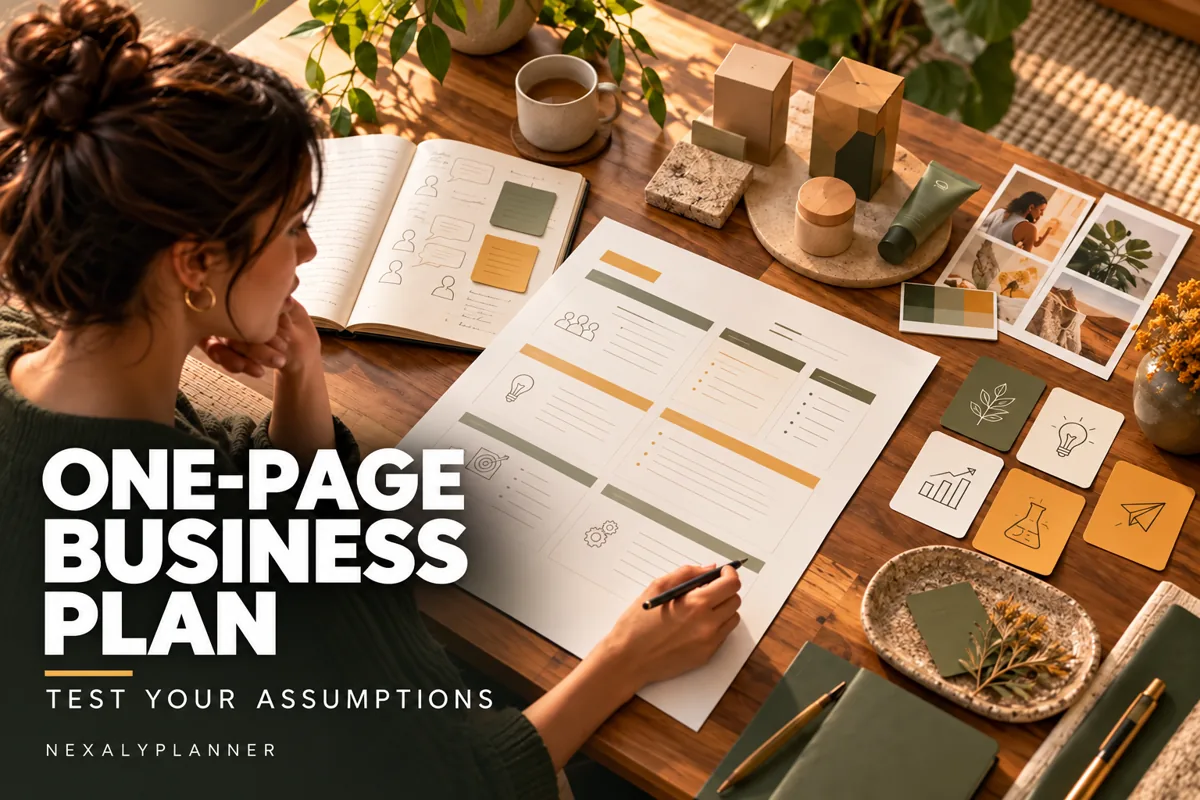
A one-page business plan is a compact set of decisions you can revise. Name the customer and offer, state the economics, then attach the assumptions that need evidence before you commit more money or time.
Use the free One-Page Business Plan Builder to enter your own assumptions, calculate the report and keep an editable backup. No account is needed.
Give each business plan section a decision
Write a specific customer, the problem and present workaround, the offer and its boundary, and the revenue/cost assumptions. Customer means who can actually buy, not everyone who might like the idea. Offer means what is included and excluded, not a slogan.
Economics means the price, delivery effort and relevant costs. The evidence log adds an assumption, observed evidence, next test, owner and due date. These sections are deliberately narrower than a complete traditional plan.
Use evidence language that does not overstate demand
The fictional designer offers one landing-page design for $1,250 with two revision rounds, excluding development. Three conversations are evidence of a discussion, not evidence of willingness to pay. Record the pricing assumption as Untested until a suitable buying test is complete. A Supported status is still your own assessment; it does not prove that a whole market exists. If the evidence contradicts the offer, keep the result visible rather than deleting the failed assumption.
Connect the price to delivery capacity
At 20 planned delivery hours, the $1,250 package produces $62.50 per planned client hour before expenses. If revisions push delivery to 26 hours, the same fee gives about $48.08 per delivery hour. Neither figure is take-home pay. Add prospecting, administration, tools and other relevant work before deciding that the package is sustainable. Use the existing freelancer-capacity planner to check available hours; this one-page builder keeps the economics as a written assumption and does not calculate margins.
Make the first 90 days a test sequence
Days 1–30: speak with suitable buyers, write the offer and run a paid pilot with clear scope. Days 31–60: inspect actual delivery hours, client objections and payment timing, then change the assumption that the evidence challenges. Days 61–90: compare repeatable acquisition, delivery capacity and collected cash before expanding. This is a fictional sequence, not a promise of clients in 90 days. Give each test its own owner and due date so the plan has a visible next action.
Know when the compact plan is insufficient
The SBA distinguishes lean and traditional business-plan formats. A short working plan can organize early decisions, but a lender, investor or other reader may request detailed forecasts, market evidence and supporting documents. The free builder is not a financing application. It usually prints compactly with up to three short assumptions; a longer evidence log can require additional pages. Keep dated JSON backups so a revised plan does not erase what you believed before a test.
Questions about a lean business plan
Is a startup business plan a separate worksheet? Not for this workflow; use the same customer, offer and evidence structure with a launch example. Are parts and elements of a business plan separate articles?
Here they are explained through the decisions above. Can the builder validate my business? No; it records the tests and evidence you provide.
Choose your next planning step
- service-business financial projections worksheet: Test the monthly money assumptions behind a service offer.
Keep a version you can review
Save on this device keeps the worksheet in the current browser. Download a JSON backup for an editable copy before changing assumptions. CSV is a calculated report; Print / Save PDF produces a browser print copy. Device saving does not provide cloud synchronization. A static PDF needs its own annotation and backup workflow.
Reference and example scope
The SBA business-plan guide distinguishes lean and traditional formats. This article adds an original operating example and does not replace the wider plan or supporting evidence a reader may request.
Connect this task to your existing plan
Freelance Business Plan: Capacity, Pricing and a 90-Day Example for the wider workflow. Small Business Planner 2026–2028 — Goals, Finance & Operations for documented features and compatibility. Paid products are separate from these free worksheets.